

 Lily James
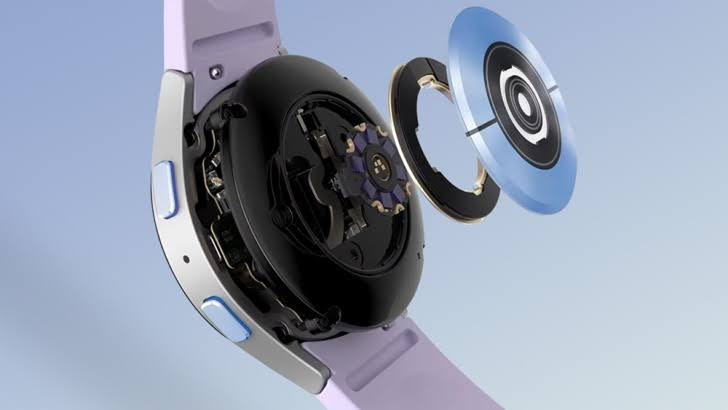
Modern mobile health monitoring has shifted from simple calorie counting to complex biometric processing. Wearable devices now continuously monitor biometrics through photoplethysmography (PPG), electrocardiography (ECG), bioelectrical impedance analysis (BIA), continuous skin temperature tracking, and photoplethysmography-based blood pressure estimation.
Smartwatches house compact sensor arrays, but their tight thermal envelopes and small battery capacities limit local data processing. Analyzing continuous health data requires significant computing power.
To solve this, wearable health systems use edge compute offloading. Raw biometric data collected by Galaxy Watches is compressed and securely transmitted to the larger processing engine of the Galaxy Fold Wide. The foldable device then handles multi-threaded data processing, neural network inference, and real-time biometric visualization on its wide aspect ratio display.
1. Sensor Fusion Architecture at the Wearable Layer
A modern wearable continuously samples biometric signals across various frequencies. Managing these high-data streams without draining the device battery requires hardware-level scheduling
Sensor Polling and Sampling Frequencies
- Photoplethysmography (PPG): Samples green, red, and infrared LED reflections at 25Hz to 100Hz to calculate heart rate variability (HRV), pulse wave velocity (PWV), and blood oxygen saturation ($SpO_2$).
- Electrocardiography (ECG): Polled at 200Hz to 500Hz to capture single-lead electrical depolarization, mapping $P$, $QRS$, and $T$ wave dynamics for arrhythmia classification.
- Bioelectrical Impedance Analysis (BIA): Uses high-frequency micro-current pulses (20kHz to 100kHz) to measure total body water, skeletal muscle mass, and body fat percentage via tissue resistance.
Local Filtering vs. Remote Offloading
A sensor hub coprocessor manages primary signal filtering directly on the watch. It uses digital signal processing (DSP) algorithms—such as finite impulse response (FIR) bandpass filtering—to remove motion artifacts and ambient light noise.
Once the data is filtered, the raw sensor signals are converted into structured time-series arrays. Instead of running heavy deep-learning algorithms on the watch processor, the system packages these arrays into encrypted, low-power data packets for offloading.
2. Low-Latency Inter-Process Communication & Bluetooth LE Protocols
Transporting real-time health data requires a fast, low-power communication pipeline between the wearable and the host smartphone.
Bluetooth LE L2CAP Credit-Based Channels
Traditional Attribute Protocol (ATT) transfers introduce unnecessary overhead for streaming time-series data. The system uses L2CAP Credit-Based Flow Control Channels over Bluetooth Low Energy (BLE), establishing direct point-to-point sockets between the wearable daemon and the mobile operating system. This cuts protocol header overhead by over 30% and keeps latency under 15 milliseconds.
Security Protocols & Dynamic Isochronous Buffering
Biometric data is encrypted at the hardware level using 128-bit AES-GCM Encryption before it reaches the Bluetooth controller’s physical layer (PHY).
The host system’s radio subsystem uses dynamic packet queuing:
- When the device is idle, data packets are held in a local FIFO buffer on the watch and sent in efficient energy bursts.
- If the user starts an active workout or the sensor detects an irregular heart rhythm, the BLE radio switches to a continuous, high-throughput transmission mode.
3. Offloaded Computation on the Host Processor
Once the encrypted payload arrives at the host device, the data moves directly to the smartphone’s specialized processing units, bypassing the main CPU cores to optimize power consumption.
Signal Processing Pipelines
The host device’s Digital Signal Processor (DSP) uses Fast Fourier Transforms (FFT) and Continuous Wavelet Transforms (CWT) to translate raw time-domain biometric inputs into frequency-domain spectrograms. This allows the system to analyze signal patterns, like subtle variations in pulse waveforms, with minimal latency.
Neural Processing Engine (NPU) Offloading
Complex machine learning models run directly on the host system’s Neural Processing Unit (NPU):
- Arrhythmia Detection Models: Convolutional Neural Networks (CNNs) evaluate ECG recordings frame-by-frame, identifying irregular heart rhythms like Atrial Fibrillation ($AFib$).
- Sleep Architecture Analysis: Multi-layer Recurrent Neural Networks (RNNs) combine heart rate, movement, skin temperature, and oxygen saturation data to map sleep stages in real time.
- Vascular Load & Arterial Stiffness: Transformer models process photoplethysmography wave shapes to calculate arterial elasticity and vascular stress markers.
4. Multi-Canvas UI Rendering on Wide Aspect Ratio Displays
Processing raw health data is only half the challenge; presenting those complex metrics clearly is just as critical. The Galaxy Fold Wide offers an expanded aspect ratio that changes how real-time biometric dashboards are rendered.
Aspect Ratio Optimization for Time-Series Data
Standard narrow smartphone displays compress time-series data, forcing users to constantly scroll or zoom. The wider layout of the Galaxy Fold Wide allows continuous ECG and PPG waveforms to be rendered side-by-side with long-term predictive health trends.
GPU Composition and Memory Bandwidth Management
Rendering high-frequency, real-time vector graphs—such as a 500Hz continuous ECG stream alongside multiple background health widgets—requires an efficient GPU pipeline:
- Hardware-Accelerated Canvas Rendering: Waveform lines are rendered as dynamic vector paths directly on the GPU, avoiding CPU-driven redraw cycles.
- Double-Buffered Frame Pipeline: Time-series arrays write to an off-screen buffer while the GPU displays the active frame. This prevents screen tearing and maintains a smooth 120Hz refresh rate across the display.
- Unified Memory Pool: Biometric arrays processed by the NPU stay in shared system memory. This allows the GPU to access and render processed health metrics instantly without copying data across memory domains.
Technical Summary of Edge-Offloaded Biometrics
The system architecture connecting Galaxy Watches to the Galaxy Fold Wide highlights the strengths of distributed edge computing in modern mobile devices.
By offloading raw biometric processing from the wearable to the smartphone, the system balances power efficiency with high-performance computing. The watch focuses on low-power continuous sensing, while the phone handles heavy signal processing, neural network analysis, and multi-window data visualization.